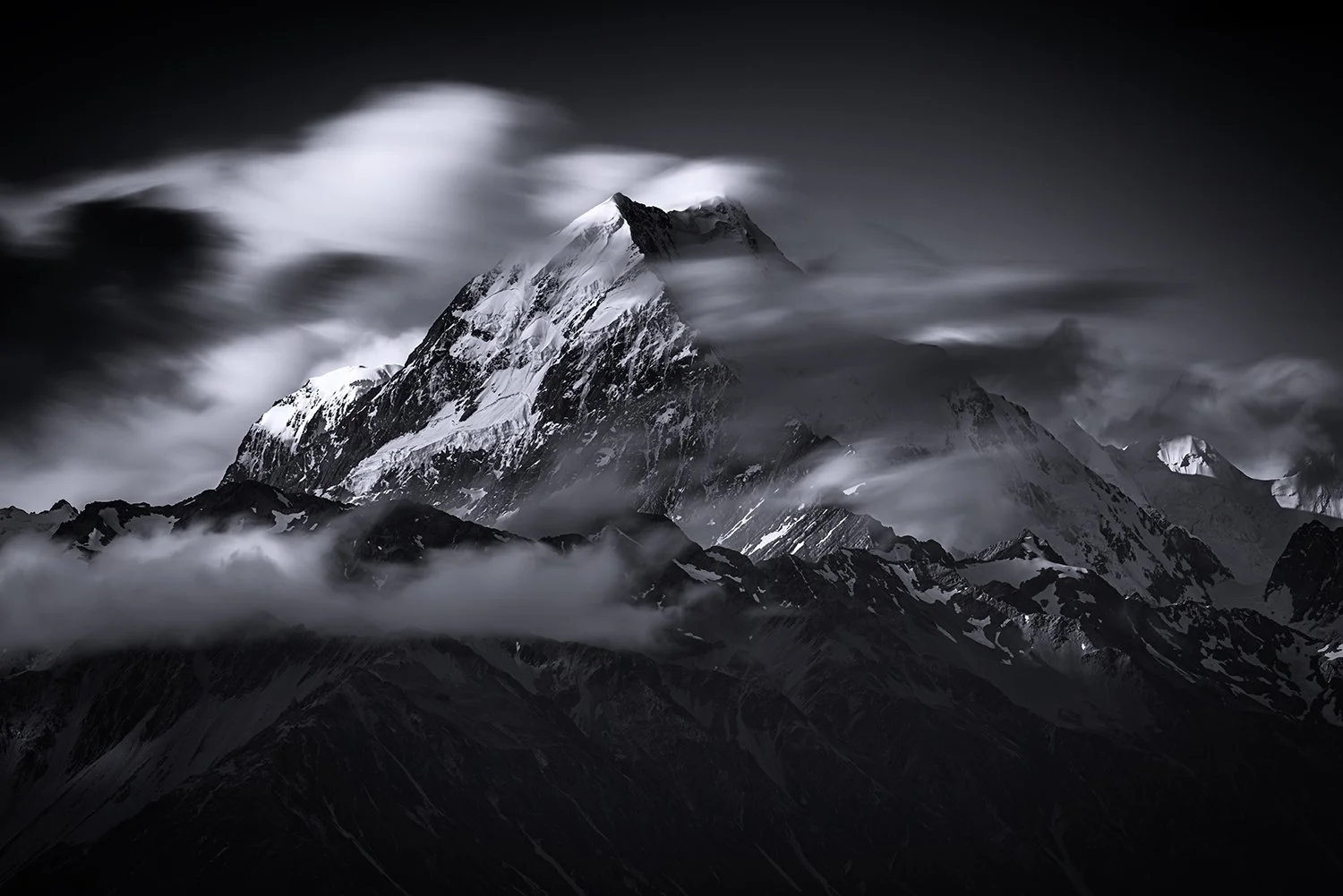
Throne of the Southern Alps — The Timeless Power of Black and White Photography
There are landscapes that impress through colour, and there are landscapes that transcend colour entirely. Throne of the Southern Alps belongs to the latter.
Captured beneath shifting alpine cloud and deep atmospheric shadow, this photograph of Aoraki / Mount Cook reveals the Southern Alps in a way that only black and white photography can truly express. Without the distraction of colour, the image becomes about structure, contrast, texture, and emotion — the essential language of monochrome photography.
For over a century, black and white imagery has carried a unique ability to transform landscapes into something timeless. From the dramatic mountain works of Ansel Adams to contemporary fine art photography, monochrome has remained one of the purest forms of visual storytelling. It strips an image back to light itself.
In Throne of the Southern Alps, the mountain emerges through drifting cloud like a monument carved from shadow. The snow-covered ridges catch narrow bands of light while the darker foreground creates depth and tension across the composition. The long tonal range allows the eye to move naturally through the image, from the low mist across the valley floor to the illuminated summit above.
Black and white photography works especially powerfully in alpine environments because mountains are naturally sculptural subjects. Rock formations, snow textures, weather systems, and dramatic changes in light all become more pronounced when reduced to tone and contrast. The absence of colour encourages a slower viewing experience, allowing shape and atmosphere to dominate.
One of the defining characteristics of monochrome landscape photography is its emotional ambiguity. Colour often tells the viewer how to feel — warm sunsets suggest comfort, vibrant greens suggest life — but black and white leaves space for interpretation. A mountain can feel majestic, isolated, intimidating, or spiritual depending on the mood carried by the light and composition.
This image was processed in the signature NIKART monochrome style, focusing on deep blacks, luminous highlights, and subtle tonal transitions to preserve both drama and detail. The movement of the clouds across the mountain creates a painterly softness against the sharp geometry of the peak itself, balancing stillness with motion.
Fine art black and white photography also has a unique relationship with interior spaces. Monochrome works integrate naturally into modern, minimalist, industrial, and contemporary interiors because they are less dependent on surrounding colour palettes. The result is an artwork that remains visually strong across different environments and design styles.
At NIKART Photography, monochrome imagery is approached not simply as a stylistic choice, but as a deliberate artistic language. Every tonal adjustment, highlight placement, and shadow detail contributes to the atmosphere of the final print. The goal is not only to document a location, but to create an image with permanence and emotional presence.
Throne of the Southern Alps is available as a limited edition fine art print through NIKART Photography in framed prints, acrylic face mount panels, canvas prints, and rolled fine art paper editions. Each piece is professionally printed in-house using archival materials to ensure exceptional detail, tonal depth, and longevity.
For collectors of monochrome fine art photography, mountain landscapes continue to hold enduring appeal because they exist outside trends. They represent scale, silence, endurance, and the raw power of the natural world — qualities that black and white photography captures with unmatched clarity.