The History of Flinders Street Station

Melbourne’s Flinders Street Station
Few buildings in Australia carry the emotional weight of Flinders Street Station. More than a transport hub, it is a civic monument — a gathering place, a meeting point, and for over a century, the silent witness to Melbourne’s daily rituals of arrival and departure.
The Beginning: 1854 – A Railway for a Growing Colony
The site became home to Australia’s first city railway station in 1854, connecting Melbourne to Sandridge (now Port Melbourne). At the time, Victoria was flush with gold rush prosperity. The city was expanding rapidly, and rail infrastructure became essential to its economic momentum.
The original structures were modest. What we recognise today did not yet exist. But the importance of the location was already clear: this would become the beating heart of Melbourne’s movement.
The Design Competition That Became Legend
In 1899, a design competition was launched to create a grand new station worthy of Melbourne’s growing stature. The winning design — attributed to railway employees James Fawcett and H.P.C. Ashworth — was bold, ornate and European in influence.
The result?
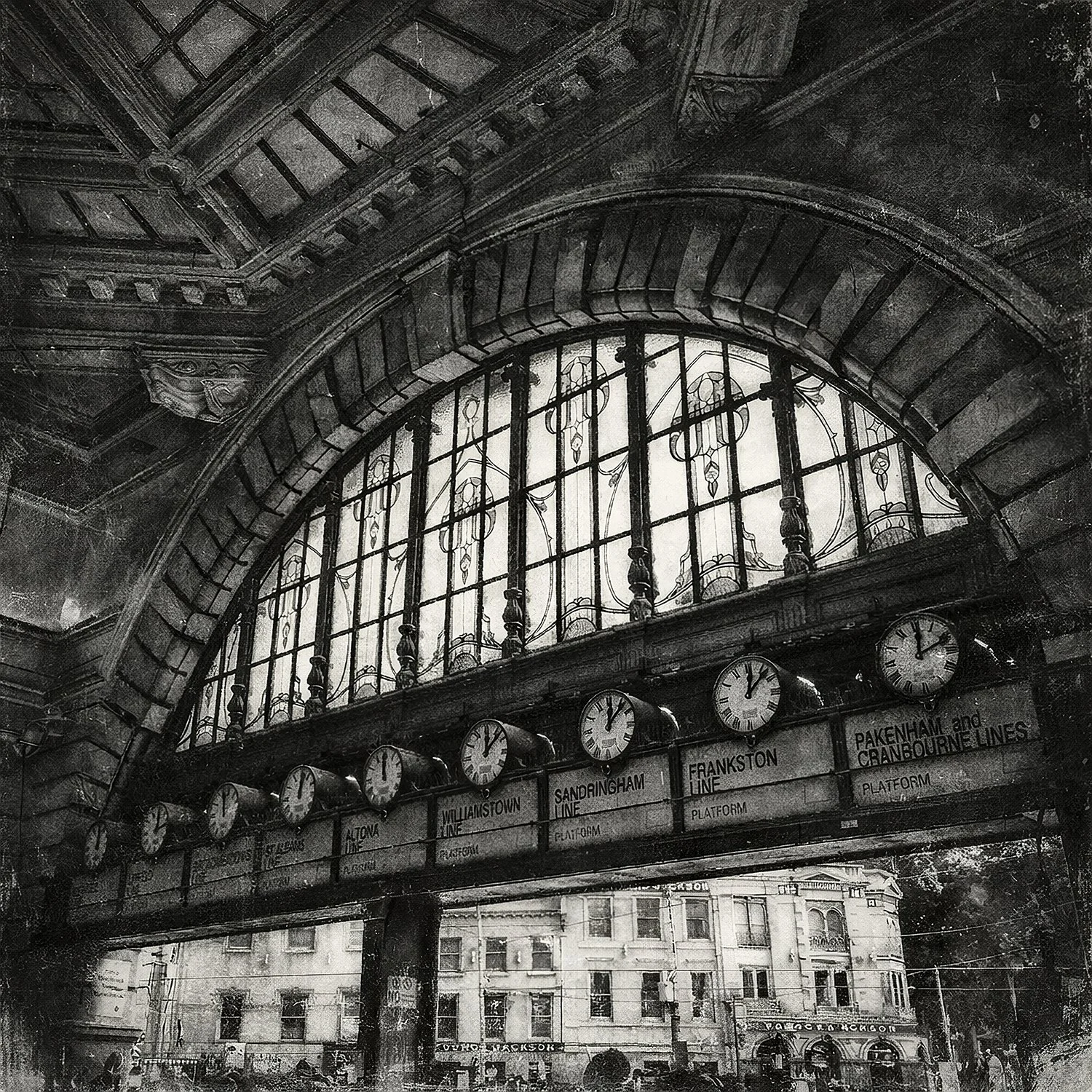
A commanding Edwardian Baroque façade, copper dome, arched windows and a row of clocks that would become iconic.
Construction began in 1905, and by 1910 the main building was complete. At the time, it was reportedly one of the busiest railway stations in the world.
“Meet Me Under the Clocks”
Perhaps no element of Flinders Street Station is more culturally significant than the clocks above the main entrance.
Originally mechanical and manually adjusted, each clock displayed the departure time for a specific train line. Station staff would climb ladders to change them.
Over time, “Meet me under the clocks” became embedded in Melbourne’s language — a phrase that transcends transport. It represents anticipation, romance, reunion, farewell.
In many ways, this is what elevates the building from infrastructure to icon.
Architectural Grandeur Inside
While the exterior commands Swanston Street, the interior reveals something almost ecclesiastical.
High vaulted ceilings. Iron and stone arches. Light filtering through arched windows. Symmetry and structure reminiscent of European train halls.
It is here that the station earns its unspoken title:
a cathedral of movement.
Your artwork, Cathedral of Departures, captures precisely this atmosphere — the convergence of time (the clocks), structure (the arches), and human transition (arrival and departure).
Wartime, Modernisation & Survival
Through both World Wars, economic depression and post-war modernisation, Flinders Street Station remained central to Melbourne life.
There were periods of neglect. Parts of the station were closed. Proposals were made to demolish or radically alter sections.
Yet the building endured.
In the 1980s and 1990s, heritage protections strengthened. Restoration projects revived architectural details that had faded or been concealed.
Today, it stands not only as a transport hub, but as a protected heritage landmark — a symbol of Melbourne’s identity.
Why It Still Matters
Flinders Street Station is more than bricks and clocks.
It represents:
Migration and opportunity
Wartime departures
Daily commuters
Lovers meeting
Families reuniting
The rhythm of the city
Architecture becomes meaningful when it absorbs human experience. Few buildings in Australia have absorbed more.
From Station to Statement Piece
In Cathedral of Departures, the station interior is transformed into something timeless — stripped of colour, reduced to light, structure and texture. Black and white intensifies the architectural drama and emphasises permanence.
For collectors, this is not simply a photograph of a building.
It is a portrait of movement, time and memory.