The Architecture of Light: When Structure Reveals Itself
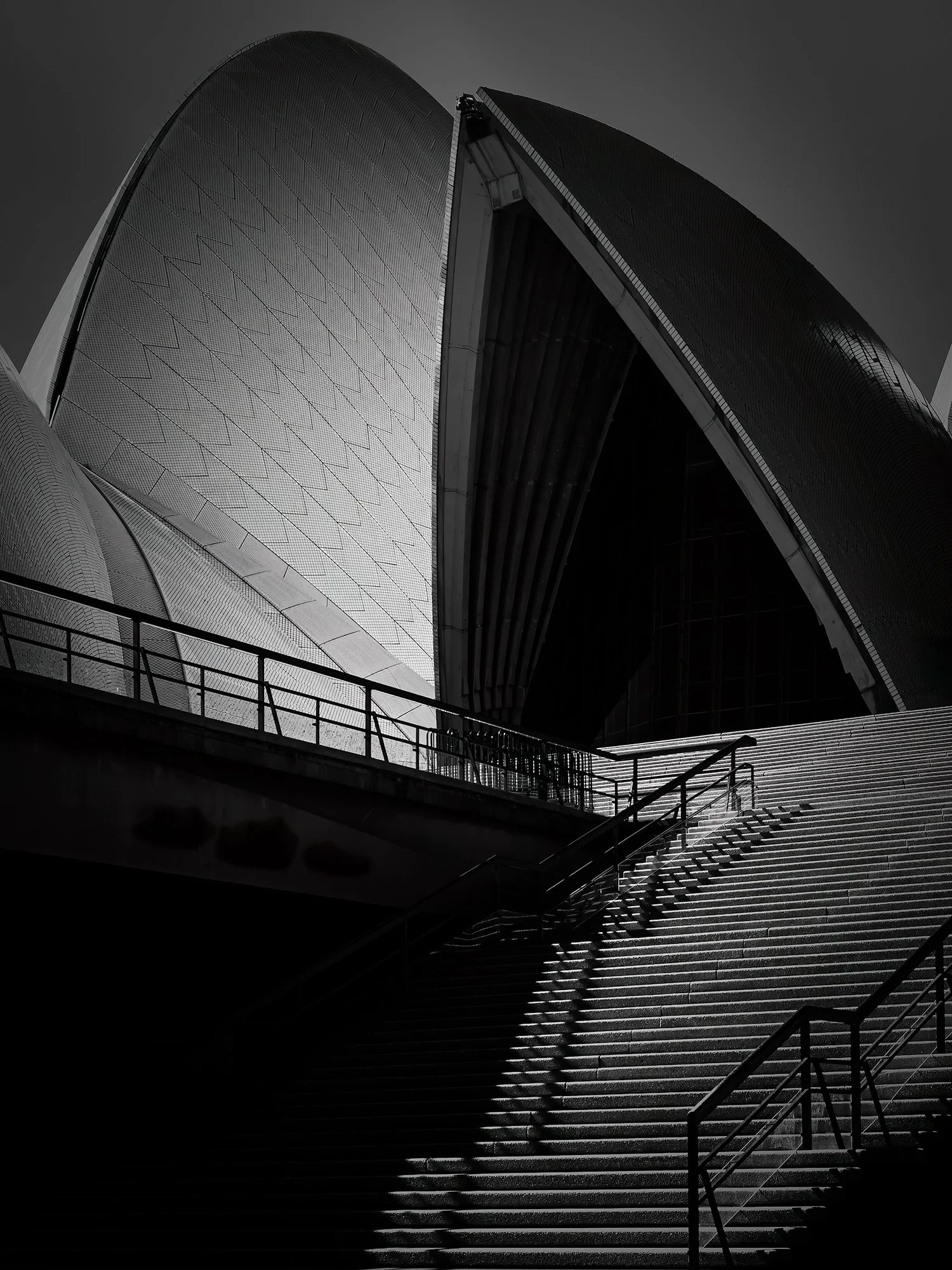
There are moments in architectural photography when a building stops being a subject and begins to organise itself into something more deliberate.
This is one of those moments.
At first glance, the structure is recognisable. The iconic forms rise upward, curved and monumental. But what defines the image is not the building itself — it is how light separates and reshapes it.
The scene is divided almost immediately.
Light claims one side. Shadow takes the other.
And between them, a clear boundary forms — not drawn, but created through contrast. This is where the image begins to simplify. Detail gives way to shape. Texture becomes secondary to form. What remains is structure in its purest sense.
The steps in the foreground introduce direction. They don’t just lead — they repeat. Each line catching light at a slightly different angle, creating a rhythm that pulls the eye upward. The handrails cut through this repetition, adding tension and interruption, preventing the image from becoming predictable.
Nothing is static.
Above, the curved surfaces respond differently to the same light. One face reflects, revealing texture and subtle tonal variation. The other recedes into darkness, becoming almost weightless. Together, they form a balance — not equal, but intentional.
This contrast is what holds the image together.
It is not about symmetry. It is about opposition.
Where one side reveals, the other conceals. Where one surface reflects, the other absorbs. And in that exchange, the structure becomes more than architecture — it becomes composition.
What is most striking is how little is actually needed.
There is no clutter. No unnecessary detail. The scene has been reduced to light, shadow, and form. Even the sky withdraws, allowing the structure to dominate without distraction.
This is where clarity is found.
Because in architectural photography, the goal is not to show everything. It is to recognise when the scene has already resolved itself — when light has done the work of editing.
In that moment, the photograph is no longer about the building.
It becomes about how structure is revealed — not through detail, but through contrast.