Laneway Nocturne: Rediscovering Melbourne in Black and White
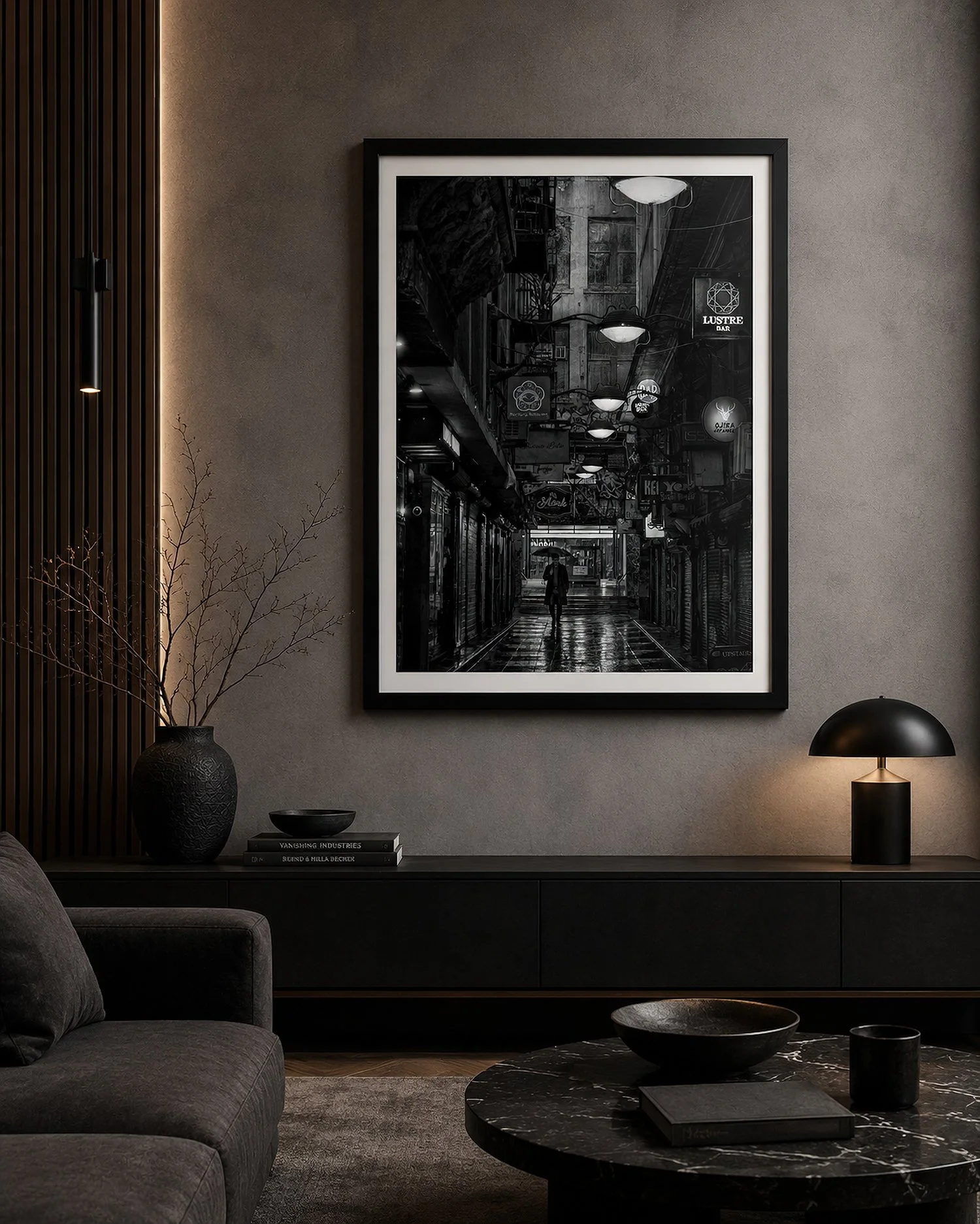
There is something about Melbourne after dark that changes the way the city speaks.
During the day, its laneways are busy, colourful and restless. Cafés open onto narrow passages, delivery vehicles compete for space, and people move quickly between work, lunch and appointments. At night, those same laneways become quieter and more mysterious. Rain darkens the pavement, old walls reveal their textures, and the glow from signs and overhead lamps creates a completely different city.
Laneway Nocturne was created within this atmosphere.
The photograph shows a solitary figure walking through a rain-soaked Melbourne laneway beneath an umbrella. Light reflects across the wet ground, while hanging signs, ageing architecture, pipes, balconies and illuminated lamps crowd the narrow space above. The scene is unmistakably urban, yet it carries a sense of stillness. Melbourne is present not as a postcard destination, but as a living city with history, atmosphere and character.
For me, this image also represents the beginning of a new photographic direction.
Why black and white?
Black-and-white photography has never simply been colour photography with the colour removed.
When colour disappears, the structure of an image becomes more important. Light, shadow, shape, texture, rhythm and contrast must carry the photograph. A bright lamp becomes a visual anchor. A wet pavement becomes a path of reflected light. Old bricks, metal shutters and weathered walls become more noticeable because there is no colour competing for attention.
Black and white can also separate a scene from a specific moment in time. The photograph may have been taken recently, yet parts of it could belong to another decade. The architecture, the overhead lights and the lone figure beneath the umbrella create a timeless quality that would be difficult to achieve in colour.
That timelessness is one of the reasons I continue to return to monochrome photography.
Colour often tells us what something looks like. Black and white can suggest what it feels like.
In Laneway Nocturne, the absence of colour strengthens the mood. The eye is drawn through the dark foreground towards the brighter opening at the end of the lane. The repeated lamps create a visual pathway above, while the figure provides scale, movement and a human connection. Without that person, the laneway would still be visually interesting, but it would feel empty. With the figure present, the scene becomes a story.
Where is he going? Has he just finished work? Is he searching for shelter from the rain? Is he familiar with the laneway, or is he discovering it for the first time?
The photograph does not provide an answer. It leaves room for the imagination.
Looking closer to home
For many years, photography has encouraged me to travel. New landscapes and unfamiliar cities naturally create excitement. When we fly overseas, we arrive with heightened awareness. We notice the streets, buildings, weather and local details because everything feels new.
But that sense of discovery should not be limited to distant places.
I was born in Melbourne and have lived here my entire life. It is the city I know best, yet I have come to realise that I have not always given it the photographic attention it deserves.
Melbourne has often been overlooked in my own work while I have focused on destinations further away. Like many photographers, I have been drawn to the drama of international travel—the mountains, coastlines, architecture and unfamiliar streets found beyond Australia. There is always another flight to book and another country to explore.
However, familiarity can sometimes prevent us from seeing what is directly in front of us.
Melbourne deserves more than an occasional photograph taken between other projects. It deserves to be studied slowly, deliberately and with the same curiosity I would bring to a city on the other side of the world.
Perhaps my next great photographic adventure does not require an airport at all.
Perhaps it begins a short distance from my own studio.
A city made for monochrome
Melbourne is particularly suited to black-and-white photography because it is a city of layers.
There is the grand architecture of the nineteenth century, the modern towers of the central business district, the industrial character of the inner west, the narrow laneways, the railway lines, the old shopfronts and the constantly changing streets. Polished glass buildings sit beside ageing brickwork. Ornate façades face contemporary structures. Light rail, trams, pedestrians, cyclists and traffic move through spaces shaped by several generations.
The weather also plays an important role.
Melbourne’s rain, mist, low clouds and sudden changes in light create opportunities that are often dismissed as inconvenient. For a photographer, however, imperfect weather can transform an ordinary location. Rain adds reflections. Mist simplifies distant buildings. Heavy clouds soften the light. Darkness allows artificial lighting to become part of the composition.
Laneway Nocturne depends on these conditions. The wet pavement reflects the overhead lamps and illuminated signs, leading the eye through the composition. The dark tones conceal some details while revealing others. The lane feels enclosed, but the illuminated area in the distance offers a sense of direction.
It is a photograph built from contrast—not only between black and white, but between darkness and light, isolation and movement, age and modernity.
A new Melbourne collection
I am currently working on a new collection of black-and-white photographs of Melbourne, scheduled for release later this year.
This series will not be a simple catalogue of familiar landmarks. My intention is to look beyond the most obvious views and explore the city through mood, architecture, weather, human presence and urban detail.
The collection will include places many people pass without noticing. Laneways after rain. Buildings seen from unusual angles. Quiet streets before the city wakes. Reflections in glass and water. The geometry of bridges, stations and modern architecture. Older structures that continue to survive among new development.
Some images will be dramatic and architectural. Others will be quieter and more reflective. Together, they will form a personal interpretation of the city in which I was born and have spent my entire life.
This is important to me because Melbourne is not simply another photographic location. It is part of my own history.
I have watched the city change. I remember buildings that no longer exist, streets before they were redeveloped and neighbourhoods before they became fashionable. Photographing Melbourne now is not only about documenting what is present. It is also about recognising how memory influences the way I see it.
The beginning of the journey
Laneway Nocturne is an early glimpse into this developing collection.
It reflects the direction I want the series to take: atmospheric, detailed, cinematic and unmistakably Melbourne. The photograph does not attempt to make the city appear perfect. Instead, it embraces the darkness, the rain, the visual clutter and the aged surfaces that give the laneway its personality.
Melbourne does not need to imitate another city to be worthy of attention. Its identity is already present in its architecture, weather, streets and people.
I simply need to slow down and look more carefully.
The new black-and-white Melbourne collection will be released later this year. Until then, I will continue walking, observing and photographing the city—often at night, often in uncertain weather and increasingly with the feeling that the next meaningful image may be much closer to home than I once believed.
This time, the adventure begins in Melbourne.